Best Places for Northern Lights Camping in Lapland (2026 Guide)
<<<<<<< HEADApril 13, 2026
Camping under the Northern Lights in remote Lapland combines high-probability aurora visibility, extreme Arctic conditions, and immersive wilderness solitude into one of the most technically rewarding yet logistically demanding travel experiences in the world.

Estimated Reading Time: 12 minutes┃Post by: Elias Varnen
The Arctic Context of Remote Lapland Camping
Lapland, stretching across northern Finland and parts of Sweden and Norway, sits directly beneath the auroral oval—a geomagnetic zone where solar particles interact with Earth’s atmosphere at peak intensity. This positioning gives the region one of the highest global probabilities of observing the Aurora Borealis. In practical terms, northern Finland records auroral activity on roughly 200 nights annually, equivalent to visibility on about every second clear night during the season.
Remote Lapland differs significantly from more accessible aurora destinations such as Tromsø or Reykjavik. Its defining characteristics are low population density, minimal artificial light, and continental climate conditions that often produce clearer skies. These factors collectively improve observational reliability compared to coastal Arctic regions where cloud cover is more persistent.
Camping in this environment introduces an additional layer of complexity. Unlike lodge-based aurora tourism, remote camping requires self-sufficiency in sub-zero conditions, navigation across snow-covered terrain, and precise timing relative to both weather systems and geomagnetic forecasts. The experience is less curated and more stochastic, but correspondingly more immersive.
About Aurora Mechanics in the Field
Auroras originate when charged particles emitted by the sun collide with atmospheric gases at altitudes exceeding 100 kilometers. These interactions produce visible emissions—predominantly green due to oxygen excitation, with occasional red, purple, and blue variations under specific energy conditions.
From a field perspective, three variables determine visibility: darkness, atmospheric clarity, and solar activity. Darkness is governed by seasonal solar angles; Lapland’s aurora season spans from late August through early April, when nights are sufficiently long.
Atmospheric clarity is often the limiting factor. Even high geomagnetic activity (e.g., elevated Kp index) yields no visible aurora under cloud cover. Consequently, experienced campers prioritize mobility—relocating campsites or using sled-based transport to chase clear skies.

Solar activity introduces probabilistic variability. While forecasts exist, they provide likelihood rather than certainty. The operational implication is that multi-night stays significantly increase success rates, as a single night rarely guarantees observation.
Seasonal Strategy and Timing Optimization
The temporal distribution of auroral activity is non-uniform. Empirical observations indicate two annual peaks aligned with the equinoxes—September–October and March–early April—when geomagnetic interactions intensify.
Winter months (December–February) offer longer nights but introduce trade-offs: extreme cold, increased cloud cover in some regions, and logistical strain. Temperatures frequently drop below −20°C (−4°F), imposing strict requirements on equipment and human endurance.
Autumn and early spring present a more balanced operational window. Nights remain sufficiently dark, while temperatures are less severe and access routes more manageable. These periods also coincide with statistically higher auroral activity, making them optimal for extended camping expeditions.
Time-of-night considerations further refine strategy. Peak visibility typically occurs between 21:00 and 01:00, though events can occur outside this window.
Site Selection and Light Pollution Constraints
Site selection in Lapland is fundamentally a problem of minimizing photon interference. Artificial light—even at low intensity—reduces contrast and obscures faint auroral structures.

Optimal campsites exhibit three characteristics:
● Distance from settlements and road networks
● Unobstructed northern horizon
● Elevated or open terrain (e.g., frozen lakes, tundra plateaus)
Frozen lakes are particularly advantageous during mid-winter, providing flat, reflective surfaces that enhance visual perception and photographic composition. However, ice thickness must be verified to ensure safety.
Forest clearings offer wind protection but may restrict sky visibility. A hybrid approach—camping near tree cover while observing from open ground—is often operationally efficient.
Equipment Systems for Sub-Arctic Camping
Camping under auroral conditions in Lapland is a systems-level exercise in thermal management and redundancy. Standard three-season gear is inadequate.
Shelter systems must withstand wind loading and snow accumulation. Four-season tents with geodesic structures are preferred. Insulation relies on layered systems: closed-cell foam pads combined with high-R-value inflatable mattresses mitigate conductive heat loss from frozen ground.
Sleeping systems require ratings significantly below expected ambient temperatures. A −30°C sleeping bag is not excessive in mid-winter scenarios.
Clothing follows a modular layering model:
● Base layer for moisture management
● Mid-layer for insulation
● Shell layer for wind and snow protection

Battery-dependent devices (cameras, GPS units) degrade rapidly in cold environments. Lithium-ion batteries lose efficiency below freezing, necessitating body-warm storage and backup units.
Risk Management and Environmental Exposure
The Arctic environment imposes non-linear risk profiles. Minor errors can escalate rapidly due to temperature, isolation, and limited rescue infrastructure.
Primary risks include hypothermia, frostbite, and navigation failure. Wind chill significantly amplifies thermal loss; a nominal −15°C environment can feel substantially colder under moderate wind conditions.
Decision-making must remain conservative. Camps should be established before darkness fully sets in, and contingency plans must account for weather deterioration.
Wildlife risk is minimal compared to other Arctic regions, but reindeer herds and terrain hazards (e.g., concealed snow drifts, thin ice) require situational awareness.
The Experiential Dimension of Aurora Camping
Despite technical demands, the experiential yield of camping under the Northern Lights is qualitatively distinct from structured tourism. The absence of artificial light and human noise produces a sensory environment defined by silence and spatial vastness.
Auroral displays vary widely—from faint, static glows to dynamic curtains and corona formations. High-intensity events can produce rapid motion and color variation, creating the impression of atmospheric fluid dynamics in real time.
Observers frequently report altered perception of scale and time during strong displays. The combination of darkness, isolation, and visual stimulus creates a cognitive environment unlike typical travel experiences.

(Table 1-Data Snapshot: Aurora Visibility in Lapland)
*These figures reinforce a central operational insight: probability is high, but certainty is unattainable.
Camping under the Northern Lights in remote Lapland is an exercise in controlled uncertainty. The region offers statistically favorable conditions—frequent auroral activity, extended seasons, and low light pollution—but the outcome remains probabilistic.
Success depends less on luck than on operational discipline: timing, site selection, equipment integrity, and risk management. For those prepared to meet these constraints, the reward is not merely visual but experiential—an encounter with a natural phenomenon in one of Earth’s least mediated environments.
(This article is for informational purposes only and does not constitute professional expedition, safety, or travel advice. Conditions in Arctic environments can change rapidly; readers should conduct independent research and consult local authorities or certified guides before undertaking remote camping in Lapland.)
Updated April 19, 2026
FAQs
1. How many nights should I plan to maximize my chances of seeing the Northern Lights?
A minimum of 3–5 nights is recommended. Given that visibility depends on both weather and solar activity, extending the duration significantly increases probability.
2. Is solo camping in Lapland advisable for beginners?
No. Arctic winter camping requires technical skills in navigation, cold-weather survival, and risk management. Beginners should consider guided expeditions.
3. Can the Northern Lights be predicted accurately?
Forecasts indicate probability based on solar activity, but precise prediction is not possible. Clear skies remain the most critical factor.
About Author
Elias Varnen is a polar travel analyst and field researcher specializing in high-latitude expedition logistics and environmental systems. With over a decade of experience across Scandinavia and the Arctic Circle, his work focuses on the intersection of climate conditions, human endurance, and remote travel strategy.
References
[1] Visit Finland. (2026). Best times to see the Northern Lights.
[2] Aurora Hunting Finland. (2025). Best months to see Northern Lights.
[3] Aurora Forecast. (2026). Northern Lights in Finland & Lapland Guide.
Stay with us to explore more precise, field-tested travel insights from the world’s most extreme destinations.
=======
April 13, 2026
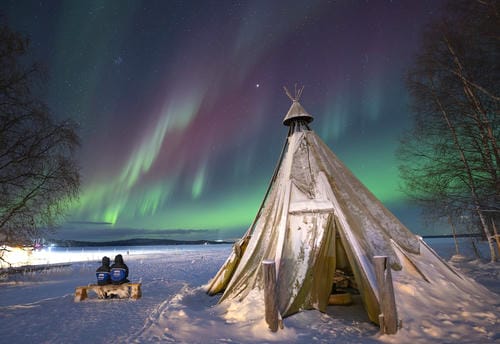
Camping under the Northern Lights in remote Lapland combines high-probability aurora visibility, extreme Arctic conditions, and immersive wilderness solitude into one of the most technically rewarding yet logistically demanding travel experiences in the world.
Estimated Reading Time: 12 minutes┃Post by: Elias Varnen
The Arctic Context of Remote Lapland Camping
Lapland, stretching across northern Finland and parts of Sweden and Norway, sits directly beneath the auroral oval—a geomagnetic zone where solar particles interact with Earth’s atmosphere at peak intensity. This positioning gives the region one of the highest global probabilities of observing the Aurora Borealis. In practical terms, northern Finland records auroral activity on roughly 200 nights annually, equivalent to visibility on about every second clear night during the season.
Remote Lapland differs significantly from more accessible aurora destinations such as Tromsø or Reykjavik. Its defining characteristics are low population density, minimal artificial light, and continental climate conditions that often produce clearer skies. These factors collectively improve observational reliability compared to coastal Arctic regions where cloud cover is more persistent.
Camping in this environment introduces an additional layer of complexity. Unlike lodge-based aurora tourism, remote camping requires self-sufficiency in sub-zero conditions, navigation across snow-covered terrain, and precise timing relative to both weather systems and geomagnetic forecasts. The experience is less curated and more stochastic, but correspondingly more immersive.
About Aurora Mechanics in the Field
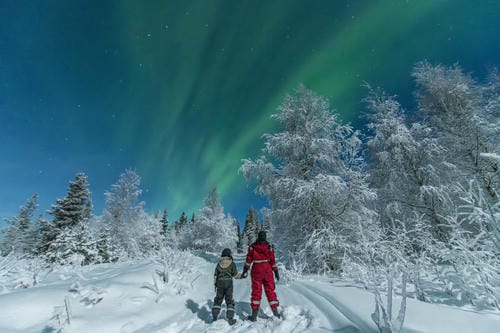
Auroras originate when charged particles emitted by the sun collide with atmospheric gases at altitudes exceeding 100 kilometers. These interactions produce visible emissions—predominantly green due to oxygen excitation, with occasional red, purple, and blue variations under specific energy conditions.
From a field perspective, three variables determine visibility: darkness, atmospheric clarity, and solar activity. Darkness is governed by seasonal solar angles; Lapland’s aurora season spans from late August through early April, when nights are sufficiently long.
Atmospheric clarity is often the limiting factor. Even high geomagnetic activity (e.g., elevated Kp index) yields no visible aurora under cloud cover. Consequently, experienced campers prioritize mobility—relocating campsites or using sled-based transport to chase clear skies.
Solar activity introduces probabilistic variability. While forecasts exist, they provide likelihood rather than certainty. The operational implication is that multi-night stays significantly increase success rates, as a single night rarely guarantees observation.
Seasonal Strategy and Timing Optimization
The temporal distribution of auroral activity is non-uniform. Empirical observations indicate two annual peaks aligned with the equinoxes—September–October and March–early April—when geomagnetic interactions intensify.
Winter months (December–February) offer longer nights but introduce trade-offs: extreme cold, increased cloud cover in some regions, and logistical strain. Temperatures frequently drop below −20°C (−4°F), imposing strict requirements on equipment and human endurance.
Autumn and early spring present a more balanced operational window. Nights remain sufficiently dark, while temperatures are less severe and access routes more manageable. These periods also coincide with statistically higher auroral activity, making them optimal for extended camping expeditions.
Time-of-night considerations further refine strategy. Peak visibility typically occurs between 21:00 and 01:00, though events can occur outside this window.
Site Selection and Light Pollution Constraints
Site selection in Lapland is fundamentally a problem of minimizing photon interference. Artificial light—even at low intensity—reduces contrast and obscures faint auroral structures.
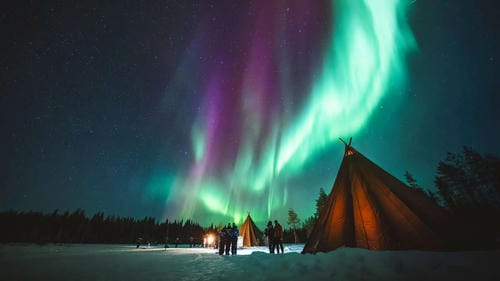
Optimal campsites exhibit three characteristics:
● Distance from settlements and road networks
● Unobstructed northern horizon
● Elevated or open terrain (e.g., frozen lakes, tundra plateaus)
Frozen lakes are particularly advantageous during mid-winter, providing flat, reflective surfaces that enhance visual perception and photographic composition. However, ice thickness must be verified to ensure safety.
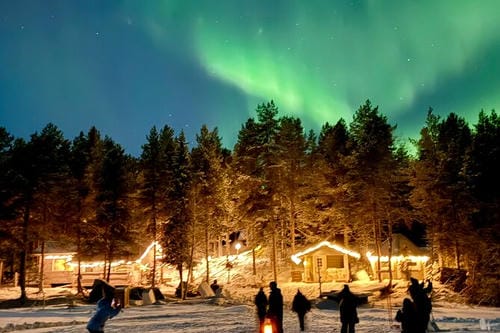
Forest clearings offer wind protection but may restrict sky visibility. A hybrid approach—camping near tree cover while observing from open ground—is often operationally efficient.
Equipment Systems for Sub-Arctic Camping
Camping under auroral conditions in Lapland is a systems-level exercise in thermal management and redundancy. Standard three-season gear is inadequate.
Shelter systems must withstand wind loading and snow accumulation. Four-season tents with geodesic structures are preferred. Insulation relies on layered systems: closed-cell foam pads combined with high-R-value inflatable mattresses mitigate conductive heat loss from frozen ground.
Sleeping systems require ratings significantly below expected ambient temperatures. A −30°C sleeping bag is not excessive in mid-winter scenarios.
Clothing follows a modular layering model:
● Base layer for moisture management
● Mid-layer for insulation
● Shell layer for wind and snow protection
Battery-dependent devices (cameras, GPS units) degrade rapidly in cold environments. Lithium-ion batteries lose efficiency below freezing, necessitating body-warm storage and backup units.
Risk Management and Environmental Exposure
The Arctic environment imposes non-linear risk profiles. Minor errors can escalate rapidly due to temperature, isolation, and limited rescue infrastructure.
Primary risks include hypothermia, frostbite, and navigation failure. Wind chill significantly amplifies thermal loss; a nominal −15°C environment can feel substantially colder under moderate wind conditions.
Decision-making must remain conservative. Camps should be established before darkness fully sets in, and contingency plans must account for weather deterioration.
Wildlife risk is minimal compared to other Arctic regions, but reindeer herds and terrain hazards (e.g., concealed snow drifts, thin ice) require situational awareness.
The Experiential Dimension of Aurora Camping
Despite technical demands, the experiential yield of camping under the Northern Lights is qualitatively distinct from structured tourism. The absence of artificial light and human noise produces a sensory environment defined by silence and spatial vastness.
Auroral displays vary widely—from faint, static glows to dynamic curtains and corona formations. High-intensity events can produce rapid motion and color variation, creating the impression of atmospheric fluid dynamics in real time.
Observers frequently report altered perception of scale and time during strong displays. The combination of darkness, isolation, and visual stimulus creates a cognitive environment unlike typical travel experiences.
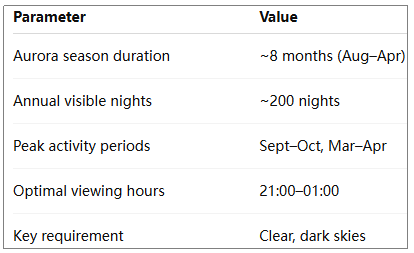
(Table 1-Data Snapshot: Aurora Visibility in Lapland)
*These figures reinforce a central operational insight: probability is high, but certainty is unattainable.
Camping under the Northern Lights in remote Lapland is an exercise in controlled uncertainty. The region offers statistically favorable conditions—frequent auroral activity, extended seasons, and low light pollution—but the outcome remains probabilistic.
Success depends less on luck than on operational discipline: timing, site selection, equipment integrity, and risk management. For those prepared to meet these constraints, the reward is not merely visual but experiential—an encounter with a natural phenomenon in one of Earth’s least mediated environments.
(This article is for informational purposes only and does not constitute professional expedition, safety, or travel advice. Conditions in Arctic environments can change rapidly; readers should conduct independent research and consult local authorities or certified guides before undertaking remote camping in Lapland.)
Updated April 19, 2026
FAQs
1. How many nights should I plan to maximize my chances of seeing the Northern Lights?
A minimum of 3–5 nights is recommended. Given that visibility depends on both weather and solar activity, extending the duration significantly increases probability.
2. Is solo camping in Lapland advisable for beginners?
No. Arctic winter camping requires technical skills in navigation, cold-weather survival, and risk management. Beginners should consider guided expeditions.
3. Can the Northern Lights be predicted accurately?
Forecasts indicate probability based on solar activity, but precise prediction is not possible. Clear skies remain the most critical factor.
About Author
Elias Varnen is a polar travel analyst and field researcher specializing in high-latitude expedition logistics and environmental systems. With over a decade of experience across Scandinavia and the Arctic Circle, his work focuses on the intersection of climate conditions, human endurance, and remote travel strategy.
References
[1] Visit Finland. (2026). Best times to see the Northern Lights.
[2] Aurora Hunting Finland. (2025). Best months to see Northern Lights.
[3] Aurora Forecast. (2026). Northern Lights in Finland & Lapland Guide.
Stay with us to explore more precise, field-tested travel insights from the world’s most extreme destinations.
>>>>>>> 944e541ebad74151114cbae6b7f1c9ca1f8a9f02
Recommended for you: