Escape into Slovenia’s Forests for an Unforgettable Mountain Biking Weekend
<<<<<<< HEADApril 20, 2026
Key Takeaways:
● Slovenia’s forests offer some of Europe’s most accessible and varied mountain biking terrain.
● Weekend trips can be designed around forest trails, alpine valleys, and bike parks within short driving distances.
● Proper planning is essential due to terrain difficulty and protected forest regulations.
● Rental bikes and guided routes are widely available in key MTB regions like Kranjska Gora and Bovec.

Estimated Reading Time: 11–13 minutes┃Post by: Luka Verdan
I. Introduction: Understanding Slovenia’s Forest Riding Environment
Slovenia is one of Europe’s most compact yet geographically diverse mountain biking destinations. Within a few hours’ drive, riders can transition from Alpine peaks to dense beech forests, karst plateaus, and river valleys. The country’s MTB infrastructure is well-developed in key regions, but riding is regulated, and many of the most rewarding experiences depend on choosing legal trails, matching terrain to skill level, and planning logistics efficiently.
Slovenia’s forests are not a single uniform riding space; they are layered across Alpine, sub-Alpine, and lowland ecosystems. Mountain biking is generally allowed on forest roads, gravel paths, and marked trails, while unmarked singletrack in protected zones is often restricted unless explicitly designated.
According to Slovenia’s national tourism authority, riding is permitted only on marked MTB routes and forest roads, with fines possible for trespassing into protected ecological zones or narrow hiking paths.
Forest riding typically falls into three broad categories:
Lowland forest routes around Ljubljana and Idrija, which are smoother and suitable for endurance riding.
Mid-altitude mixed terrain in regions like Kranjska Gora and Škofja Loka, combining forest climbs with technical descents.
Alpine forest zones in areas such as Bovec and the Soča Valley, where steep gradients and root-heavy trails dominate.

Choosing the right trail depends on rider experience, available time, and desired scenery. Local trail maps are accessible online through Slovenia Trails (www.slovenia-trails.si), which provides updated trail conditions and GPS coordinates.
II.Preparation
2.1 Equipment
A weekend forest MTB trip in Slovenia requires equipment suited for variable terrain. Hardtail bikes are sufficient for lowland forest routes but less suitable for alpine singletrack. Full suspension bikes are recommended for mixed or technical terrain.
Essential considerations include tire width and tread pattern, as forest routes often transition between gravel and root-heavy surfaces. Tubeless setups are strongly recommended due to thorny vegetation and rocky sections.
Proper equipment is vital for a safe mountain biking weekend. Recommended essentials include:
● Mountain Bike Type: Hardtail for lighter trails; full-suspension for technical forest tracks.
● Protective Gear: Helmet, gloves, knee and elbow pads.
● Navigation Tools: GPS device or smartphone with offline trail maps.
● Repair Kit: Spare tubes, multi-tool, pump, and chain lubricant.
● Hydration and Nutrition: At least 1.5 liters of water per rider; energy bars for longer rides.
Slovenia has several rental shops near popular trailheads. Kranjska Gora and Bled provide high-quality mountain bikes and safety equipment for tourists, minimizing the need to transport personal gear.
2.2 Technical Preparation
While major regions are well signposted, forest intersections can be complex, and offline GPS mapping tools are commonly used. Inform someone of your planned route; mobile coverage can be intermittent.
Check local weather forecasts; rain can increase trail slipperiness and river crossing risks.Weather variability also necessitates layered clothing systems. Even in summer, alpine forest zones can experience temperature drops of 10–15°C between valley floors and higher elevations.
Respect wildlife and maintain trails’ ecological integrity. Avoid leaving trash, and stay on marked paths.
2.3 Seasonal Timing and Weather Considerations
The optimal season for forest mountain biking in Slovenia is late May through early October. During this window, trails are typically dry, and forest canopies provide shade on lower-altitude routes.

Spring conditions can include muddy forest roads due to snowmelt, particularly above 1,200 meters. Summer brings stable conditions but higher tourist traffic in Alpine regions. Autumn offers some of the most stable riding conditions, with firm ground and reduced crowds.
Rain can dramatically affect forest trail safety, especially on clay-heavy soil sections common in some lowland regions. Riders should check local trail conditions before departure, as certain forest routes may temporarily close after heavy rainfall.
III. How to Get Your Destination?
Most international riders access Slovenia via Ljubljana Airport, with onward transport to MTB regions by rental car or shuttle services. Public transport is limited for forest trail access, especially in alpine areas.
A key logistical consideration is trailhead access. Many forest routes begin on gravel roads above towns rather than directly in urban centers, meaning a short uphill transfer ride or vehicle shuttle is often necessary.
Parking is generally straightforward in designated MTB regions, but in peak summer months, alpine valley access roads may become congested between 09:00 and 12:00.
IV. Planning a Two-Day Riding Structure
A weekend mountain bike escape in Slovenia should be structured around two distinct ride types: one endurance-focused day and one technical or exploration-focused day.

A typical structure might involve:
Day 1: Arrival + medium-distance forest loop ride (20–40 km)
Day 2: Longer alpine forest ride or bike park session (30–60 km depending on fitness)
Elevation gain is a critical factor. Even moderate forest routes often include 800–1,500 meters of climbing per day due to Slovenia’s steep topography. For example, popular alpine MTB routes frequently exceed 1,000 meters of elevation gain within 30–50 km distances .
Time management is equally important. Forest terrain reduces average speed significantly compared to road cycling. A 30 km forest ride may require 3–5 hours depending on technical difficulty.
V. Risk Management and Forest Regulations
Slovenian forest trails vary significantly in technical demand, even within the same region. Riders should match trail selection to both technical skill and bike setup.
Forest road riding is typically non-technical but physically demanding due to gradient.
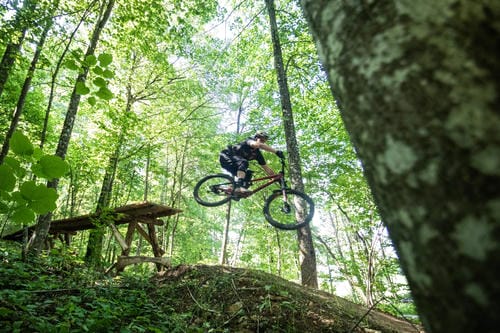
Singletrack forest trails often include roots, rock gardens, and narrow switchbacks.
Bike park trails introduce structured flow sections, jumps, and graded difficulty levels.
Difficulty classification in Slovenia commonly follows international MTB standards (blue/red/black grading), though local interpretation can vary by region and operator.

Slovenia enforces clear rules regarding forest use. Riding off marked trails or entering protected hiking paths can result in fines. Certain national park areas also restrict cycling entirely or limit it to designated roads.
Riders should remain aware of shared trail usage with hikers and wildlife activity zones, particularly in alpine forest ecosystems where encounters with protected species are possible.
Emergency response times in remote forest areas can be longer than urban averages, making self-sufficiency and route planning critical.
Conclusion
A weekend mountain bike escape in Slovenia’s forests is highly efficient to organize but demands careful planning. The country’s compact geography enables rapid transitions between terrain types, yet the complexity of forest systems requires disciplined route selection and awareness of regulations. Riders who match region, skill level, and equipment appropriately can experience a high-density MTB environment within just two days of travel.
(The information provided in this article is intended for general travel and mountain biking guidance only. Trail conditions, weather, and terrain can vary rapidly, and riding in forested or alpine areas carries inherent risks, including falls, collisions, exposure to wildlife, and sudden weather changes. Readers are responsible for evaluating their own fitness, equipment, and local conditions before undertaking any ride described here. The author, publisher, and associated organizations assume no liability for accidents, injuries, or property damage resulting from the use of this content. Always wear appropriate safety gear, carry sufficient water and supplies, and inform someone of your planned route. For specialized advice on trail conditions or medical considerations, consult local guides or health professionals.)
FAQs
1. Do I need a guide for mountain biking in Slovenia’s forests?
Not necessarily, but guides are recommended for first-time visitors in alpine regions like Bovec or Kranjska Gora due to complex trail networks.
2. Can beginners ride forest trails in Slovenia?
Yes, but beginners should stick to marked gravel forest roads or easier blue-rated routes, especially in lowland regions.
3. Is e-MTB useful for a weekend trip?
Yes. E-MTBs are widely used in Slovenia and are particularly helpful for steep forest climbs and maximizing limited weekend time.
About Author
Luka Verdan is a professional outdoor adventure journalist, certified mountain biking instructor, and travel writer with over 12 years of experience exploring Europe’s cycling trails. Her expertise includes planning weekend escapes, mountain bike training, and combining cultural exploration with outdoor adventure. Luka has contributed to international travel publications and has led guided mountain biking tours in Slovenia, Austria, and the Balkans.
For readers seeking personalized advice or guided tour planning, Luka can be reached via her professional email: [email protected]. She welcomes questions on trail selection, gear recommendations, or multi-day itineraries, though response times may vary based on tour season availability.
Explore more destination-focused outdoor guides and plan your next adventure across Europe’s most dynamic landscapes.
=======
April 20, 2026
Key Takeaways:
● Slovenia’s forests offer some of Europe’s most accessible and varied mountain biking terrain.
● Weekend trips can be designed around forest trails, alpine valleys, and bike parks within short driving distances.
● Proper planning is essential due to terrain difficulty and protected forest regulations.
● Rental bikes and guided routes are widely available in key MTB regions like Kranjska Gora and Bovec.
Estimated Reading Time: 11–13 minutes┃Post by: Luka Verdan
I. Introduction: Understanding Slovenia’s Forest Riding Environment
Slovenia is one of Europe’s most compact yet geographically diverse mountain biking destinations. Within a few hours’ drive, riders can transition from Alpine peaks to dense beech forests, karst plateaus, and river valleys. The country’s MTB infrastructure is well-developed in key regions, but riding is regulated, and many of the most rewarding experiences depend on choosing legal trails, matching terrain to skill level, and planning logistics efficiently.
Slovenia’s forests are not a single uniform riding space; they are layered across Alpine, sub-Alpine, and lowland ecosystems. Mountain biking is generally allowed on forest roads, gravel paths, and marked trails, while unmarked singletrack in protected zones is often restricted unless explicitly designated.
According to Slovenia’s national tourism authority, riding is permitted only on marked MTB routes and forest roads, with fines possible for trespassing into protected ecological zones or narrow hiking paths.
Forest riding typically falls into three broad categories:
Lowland forest routes around Ljubljana and Idrija, which are smoother and suitable for endurance riding.
Mid-altitude mixed terrain in regions like Kranjska Gora and Škofja Loka, combining forest climbs with technical descents.
Alpine forest zones in areas such as Bovec and the Soča Valley, where steep gradients and root-heavy trails dominate.
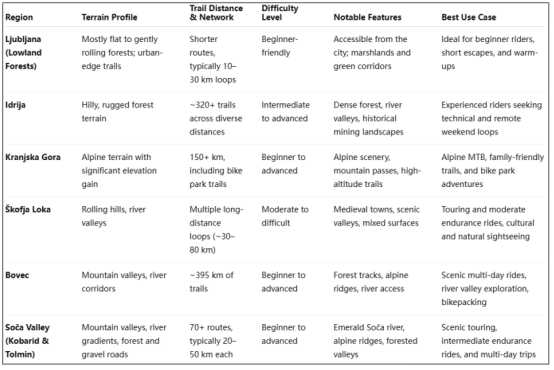
Choosing the right trail depends on rider experience, available time, and desired scenery. Local trail maps are accessible online through Slovenia Trails (www.slovenia-trails.si), which provides updated trail conditions and GPS coordinates.
II.Preparation
2.1 Equipment
A weekend forest MTB trip in Slovenia requires equipment suited for variable terrain. Hardtail bikes are sufficient for lowland forest routes but less suitable for alpine singletrack. Full suspension bikes are recommended for mixed or technical terrain.
Essential considerations include tire width and tread pattern, as forest routes often transition between gravel and root-heavy surfaces. Tubeless setups are strongly recommended due to thorny vegetation and rocky sections.
Proper equipment is vital for a safe mountain biking weekend. Recommended essentials include:
● Mountain Bike Type: Hardtail for lighter trails; full-suspension for technical forest tracks.
● Protective Gear: Helmet, gloves, knee and elbow pads.
● Navigation Tools: GPS device or smartphone with offline trail maps.
● Repair Kit: Spare tubes, multi-tool, pump, and chain lubricant.
● Hydration and Nutrition: At least 1.5 liters of water per rider; energy bars for longer rides.
Slovenia has several rental shops near popular trailheads. Kranjska Gora and Bled provide high-quality mountain bikes and safety equipment for tourists, minimizing the need to transport personal gear.
2.2 Technical Preparation
While major regions are well signposted, forest intersections can be complex, and offline GPS mapping tools are commonly used. Inform someone of your planned route; mobile coverage can be intermittent.
Check local weather forecasts; rain can increase trail slipperiness and river crossing risks.Weather variability also necessitates layered clothing systems. Even in summer, alpine forest zones can experience temperature drops of 10–15°C between valley floors and higher elevations.
Respect wildlife and maintain trails’ ecological integrity. Avoid leaving trash, and stay on marked paths.
2.3 Seasonal Timing and Weather Considerations
The optimal season for forest mountain biking in Slovenia is late May through early October. During this window, trails are typically dry, and forest canopies provide shade on lower-altitude routes.
Spring conditions can include muddy forest roads due to snowmelt, particularly above 1,200 meters. Summer brings stable conditions but higher tourist traffic in Alpine regions. Autumn offers some of the most stable riding conditions, with firm ground and reduced crowds.
Rain can dramatically affect forest trail safety, especially on clay-heavy soil sections common in some lowland regions. Riders should check local trail conditions before departure, as certain forest routes may temporarily close after heavy rainfall.
III. How to Get Your Destination?
Most international riders access Slovenia via Ljubljana Airport, with onward transport to MTB regions by rental car or shuttle services. Public transport is limited for forest trail access, especially in alpine areas.
A key logistical consideration is trailhead access. Many forest routes begin on gravel roads above towns rather than directly in urban centers, meaning a short uphill transfer ride or vehicle shuttle is often necessary.
Parking is generally straightforward in designated MTB regions, but in peak summer months, alpine valley access roads may become congested between 09:00 and 12:00.
IV. Planning a Two-Day Riding Structure
A weekend mountain bike escape in Slovenia should be structured around two distinct ride types: one endurance-focused day and one technical or exploration-focused day.
A typical structure might involve:
Day 1: Arrival + medium-distance forest loop ride (20–40 km)
Day 2: Longer alpine forest ride or bike park session (30–60 km depending on fitness)
Elevation gain is a critical factor. Even moderate forest routes often include 800–1,500 meters of climbing per day due to Slovenia’s steep topography. For example, popular alpine MTB routes frequently exceed 1,000 meters of elevation gain within 30–50 km distances .
Time management is equally important. Forest terrain reduces average speed significantly compared to road cycling. A 30 km forest ride may require 3–5 hours depending on technical difficulty.
V. Risk Management and Forest Regulations
Slovenian forest trails vary significantly in technical demand, even within the same region. Riders should match trail selection to both technical skill and bike setup.
Forest road riding is typically non-technical but physically demanding due to gradient.
Singletrack forest trails often include roots, rock gardens, and narrow switchbacks.
Bike park trails introduce structured flow sections, jumps, and graded difficulty levels.
Difficulty classification in Slovenia commonly follows international MTB standards (blue/red/black grading), though local interpretation can vary by region and operator.
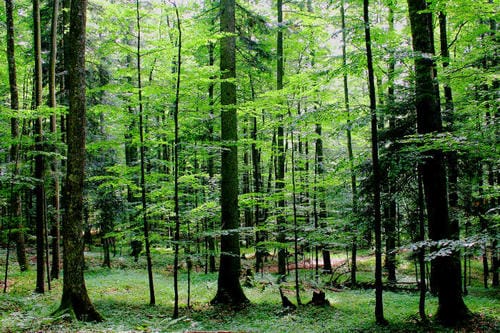
Slovenia enforces clear rules regarding forest use. Riding off marked trails or entering protected hiking paths can result in fines. Certain national park areas also restrict cycling entirely or limit it to designated roads.
Riders should remain aware of shared trail usage with hikers and wildlife activity zones, particularly in alpine forest ecosystems where encounters with protected species are possible.
Emergency response times in remote forest areas can be longer than urban averages, making self-sufficiency and route planning critical.
Conclusion
A weekend mountain bike escape in Slovenia’s forests is highly efficient to organize but demands careful planning. The country’s compact geography enables rapid transitions between terrain types, yet the complexity of forest systems requires disciplined route selection and awareness of regulations. Riders who match region, skill level, and equipment appropriately can experience a high-density MTB environment within just two days of travel.
(The information provided in this article is intended for general travel and mountain biking guidance only. Trail conditions, weather, and terrain can vary rapidly, and riding in forested or alpine areas carries inherent risks, including falls, collisions, exposure to wildlife, and sudden weather changes. Readers are responsible for evaluating their own fitness, equipment, and local conditions before undertaking any ride described here. The author, publisher, and associated organizations assume no liability for accidents, injuries, or property damage resulting from the use of this content. Always wear appropriate safety gear, carry sufficient water and supplies, and inform someone of your planned route. For specialized advice on trail conditions or medical considerations, consult local guides or health professionals.)
FAQs
1. Do I need a guide for mountain biking in Slovenia’s forests?
Not necessarily, but guides are recommended for first-time visitors in alpine regions like Bovec or Kranjska Gora due to complex trail networks.
2. Can beginners ride forest trails in Slovenia?
Yes, but beginners should stick to marked gravel forest roads or easier blue-rated routes, especially in lowland regions.
3. Is e-MTB useful for a weekend trip?
Yes. E-MTBs are widely used in Slovenia and are particularly helpful for steep forest climbs and maximizing limited weekend time.
About Author
Luka Verdan is a professional outdoor adventure journalist, certified mountain biking instructor, and travel writer with over 12 years of experience exploring Europe’s cycling trails. Her expertise includes planning weekend escapes, mountain bike training, and combining cultural exploration with outdoor adventure. Luka has contributed to international travel publications and has led guided mountain biking tours in Slovenia, Austria, and the Balkans.
For readers seeking personalized advice or guided tour planning, Luka can be reached via her professional email: [email protected]. She welcomes questions on trail selection, gear recommendations, or multi-day itineraries, though response times may vary based on tour season availability.
Explore more destination-focused outdoor guides and plan your next adventure across Europe’s most dynamic landscapes.
>>>>>>> 944e541ebad74151114cbae6b7f1c9ca1f8a9f02
Recommended for you: