Snowshoeing Trails Near the Rockies That Don’t Require a Guide
<<<<<<< HEADApril 20, 2026
Key Highlights:
● Snowshoeing near the Rockies offers accessible winter exploration without hiring a guide.
● Many classic hiking routes become safe, scenic snowshoe trails in winter conditions.
● Popular beginner-friendly areas include frozen lakes, forest corridors, and old park roads.
● Avalanche awareness and weather preparation remain essential even on easy routes.
● Proper gear and route selection make self-guided trips both safe and rewarding.

Estimated Reading Time: 11–13 minutes┃ Post by: Adrian Calloway
I. Introduction: Self-Guided Snowshoeing in the Rocky Mountain Region
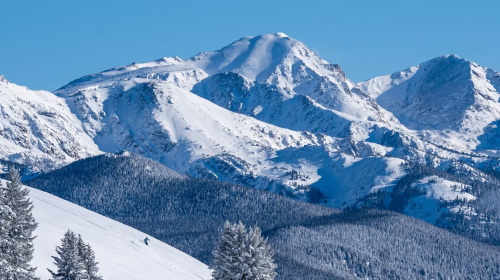
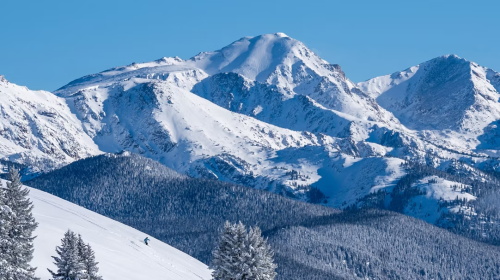
Snowshoeing across the Rocky Mountain region has become one of the most accessible ways to experience high-alpine winter environments without technical mountaineering skills or guided tours. The premise is simple: strap snowshoes over insulated boots and move across snow-covered terrain that would otherwise be impassable on foot. In areas like Colorado’s Rocky Mountain National Park and surrounding public lands, dozens of established summer hiking routes transform into winter corridors suitable for independent exploration.
The key distinction between guided and self-guided snowshoeing in this region is not difficulty, but decision-making. Most beginner-to-intermediate routes remain navigable without professional guidance if travelers stay on established corridors, avoid steep avalanche terrain, and understand winter travel conditions. According to the U.S. National Park Service, many high-elevation trails across Rocky Mountain National Park are routinely used for snowshoeing throughout winter and early spring when snowpack is sufficient for flotation and stability.
II. What Makes a Snowshoe Trail “Guide-Free” in the Rockies
Not all winter terrain is appropriate for independent travel, even if it appears simple on a map. Guide-free snowshoe trails share three defining characteristics: low avalanche exposure, clear navigation markers or obvious corridors, and frequent winter use that packs down snow.
In the Rockies, many of these routes follow old park roads or heavily trafficked hiking corridors. These areas reduce route-finding complexity, which is often the biggest risk factor for inexperienced winter travelers. Even in relatively safe zones, conditions can vary significantly depending on snowfall, wind loading, and temperature fluctuations.
Avalanche risk remains the central constraint. Slopes above roughly 30 degrees can release snow under certain conditions, even if the terrain appears benign at the surface. This means that “easy” trails are defined less by distance and more by terrain geometry and exposure.
A practical classification used by experienced winter hikers in the region looks like this:

Only the first three categories are suitable for independent snowshoe travel without a guide.
III. Rocky Mountain National Park: Core Self-Guided Routes
Rocky Mountain National Park remains the most concentrated area for beginner-friendly snowshoeing near the central Rockies. The Bear Lake Road corridor and surrounding valleys offer a cluster of routes that are frequently used in winter and do not require guided access.
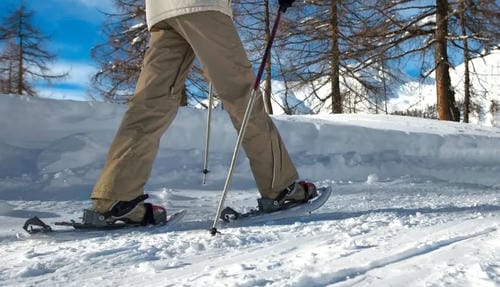
One of the most accessible options is Sprague Lake, a flat loop under a mile in length. The terrain is nearly level, making it suitable for first-time snowshoers and families. Nearby, the Bear Lake area serves as a gateway into deeper terrain, where snowshoe tracks often lead toward Dream Lake and Emerald Lake. These routes are more demanding but still commonly used without guides due to their established winter traffic and visible pathing.
Typical self-guided routes in this area include:
1. Bear Lake Trail – Rocky Mountain National Park, Colorado
● Distance: 0.6 miles loop
● Elevation Gain: 50 feet
● Difficulty: Easy
● Highlights: Panoramic views of Hallett Peak, frozen Bear Lake, wildlife spotting.
Notes: Well-maintained paths and clearly marked signs make this trail suitable for families and beginners.
2. Sprague Lake Trail – Rocky Mountain National Park, Colorado
● Distance: 0.8 miles loop
● Elevation Gain: Minimal
● Difficulty: Easy
● Highlights: Frozen lake, reflection photography opportunities, birdwatching.
Notes: Ideal for a short excursion or as part of a larger snowshoeing day.
3. The Emerald Lake Corridor – Rocky Mountain National Park, Colorado
● Distance: ~3.6 miles round trip
● Elevation Gain: ~650–770 feet
● Difficulty: Moderate (season-dependent in winter snow conditions)
● Highlights: Nymph Lake, Dream Lake, Emerald Lake, alpine cirque views, Hallett Peak backdrop
● Trailhead: Bear Lake Trailhead, Rocky Mountain National Park
The Emerald Lake corridor, in particular, is one of the most heavily traveled winter routes in the park. While it gains elevation, it remains intuitive due to constant use by snowshoers and winter hikers, which compresses the snow into a defined track.

IV. Estes Park and Western Approaches: Quiet Alternatives
Outside the main Bear Lake corridor, quieter snowshoeing experiences can be found near Estes Park and the western entrances of the park. These areas are often less congested but still suitable for independent travel.
The Lily Lake area provides one of the simplest snowshoe loops in the region. The trail remains relatively flat with minimal elevation gain, making it suitable for acclimatization before attempting higher routes. Similarly, sections around the Glacier Basin and Moraine Park areas offer wide, open valleys where navigation is straightforward and avalanche exposure is limited.
Local winter travel guides often emphasize that in these lower-elevation basins, snowshoeing becomes more about endurance than technical skill. The snow tends to be packed by wind and previous hikers, reducing the physical burden compared to untouched powder conditions.
V. Lesser-Known but Accessible Snowshoe Corridors
Beyond the most famous trails, several self-guided routes exist across the broader Rocky Mountain region that avoid technical complexity while still delivering high-quality scenery.
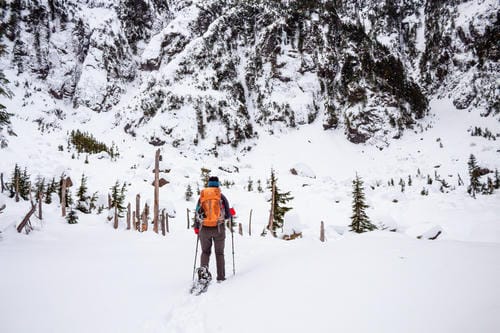
Old park roads are particularly important in this category. Roads that are closed to vehicles in winter often become snowshoe corridors due to their consistent grade and predictable direction. These routes are especially useful after heavy snowfall, when forest trails may become difficult to follow.

Common characteristics of these corridors include:
● Gentle, sustained incline rather than steep ascent
● Wide surface area allowing flexible navigation
● Frequent use by both snowshoers and cross-country skiers
● Minimal exposure to avalanche-prone slopes
These routes are not “official snowshoe trails” in many cases, but functionally they serve as the safest entry point for independent winter exploration in the Rockies.
VI. Safety Considerations for Independent Snowshoe Travel
Weather Awareness: The most significant hazard remains avalanche terrain, even in areas that appear forested or benign. The U.S. National Park Service emphasizes that snowshoe travelers should check avalanche forecasts, avoid slopes above 30 degrees when risk is present.
Navigation: Use maps, trail apps, or GPS devices. Even well-marked trails can be confusing after heavy snowfall.
Emergency Preparedness: Carry a first aid kit, extra food and water, and a charged mobile device. Notify someone of your planned route.
Clothing & Gear: Layering is essential. Wear moisture-wicking base layers, insulating mid-layers, and a waterproof outer shell. Gloves, hats, and gaiters protect extremities.

Essential considerations include:
● Snow depth significantly affects travel speed and fatigue
● Route familiarity reduces exposure to navigation errors
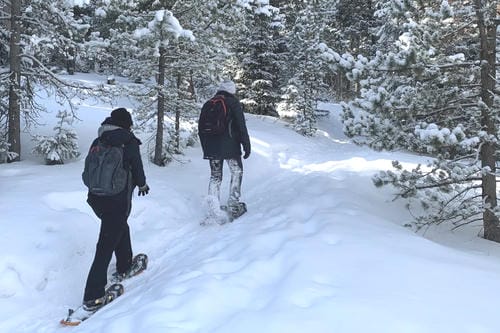
● Forest cover generally provides safer terrain than open alpine basins
● Physical exertion increases substantially compared to summer hiking
Even experienced hikers often reduce planned distances by half when transitioning to snowshoe conditions.
VII. Planning a Self-Guided Snowshoe Day
Effective planning in the Rockies requires adjusting expectations rather than simply transferring summer hiking logic into winter conditions. A 3-mile summer hike may take significantly longer in snow due to increased resistance and slower movement.
A typical self-guided winter day in the Rockies might include:
● Short morning approach on a packed corridor
● Midday ascent to a lake basin or viewpoint
● Early return before weather deterioration
Route selection should prioritize visibility and retreat options rather than elevation gain. Many successful snowshoe trips in the region are loop-based or out-and-back routes that allow easy reversal if conditions worsen.
(This article is for informational purposes only and does not constitute professional travel, navigation, or safety advice. Snowshoeing involves inherent risks, including sudden weather changes, avalanche exposure, and terrain hazards. Trail conditions can change rapidly, and readers are responsible for verifying current local conditions and exercising proper judgment before any trip. All activities are undertaken at the reader’s own risk.)
FAQs
1. Do I need snowshoeing experience to try these trails near the Rockies?
No prior experience is required for most beginner routes like Sprague Lake or Lily Lake, though basic winter hiking awareness is strongly recommended.
2. Can I snowshoe in Rocky Mountain National Park without a permit or guide?
Yes, most winter trails are open for self-guided travel, but park entry fees and seasonal access rules still apply.
3. What is the biggest risk when snowshoeing without a guide?
Avalanche exposure and navigation errors in changing weather conditions are the primary risks, even on moderate trails.
About Author
Adrian Calloway is a travel writer specializing in alpine environments, winter trekking, and backcountry route design across North America. His work focuses on translating technical mountain conditions into practical guidance for independent travelers seeking safe access to high-elevation landscapes. He has spent over a decade documenting winter travel corridors in the Rocky Mountain region and adjacent ranges.
References
[1] National Park Service. (2026). Snowshoeing in Rocky Mountain National Park.
[2] AllTrails. (2025). Snowshoeing trails in Rocky Mountain National Park.
[3] Snowshoe Magazine. (2023). Snowshoeing trails in Rocky Mountain National Park, CO.
If you enjoy exploring alpine winter routes like these, stay on this blog for more detailed field-tested guides to cold-season travel.
=======April 20, 2026
Key Highlights:
● Snowshoeing near the Rockies offers accessible winter exploration without hiring a guide.
● Many classic hiking routes become safe, scenic snowshoe trails in winter conditions.
● Popular beginner-friendly areas include frozen lakes, forest corridors, and old park roads.
● Avalanche awareness and weather preparation remain essential even on easy routes.
● Proper gear and route selection make self-guided trips both safe and rewarding.
Estimated Reading Time: 11–13 minutes┃ Post by: Adrian Calloway
I. Introduction: Self-Guided Snowshoeing in the Rocky Mountain Region
Snowshoeing across the Rocky Mountain region has become one of the most accessible ways to experience high-alpine winter environments without technical mountaineering skills or guided tours. The premise is simple: strap snowshoes over insulated boots and move across snow-covered terrain that would otherwise be impassable on foot. In areas like Colorado’s Rocky Mountain National Park and surrounding public lands, dozens of established summer hiking routes transform into winter corridors suitable for independent exploration.
The key distinction between guided and self-guided snowshoeing in this region is not difficulty, but decision-making. Most beginner-to-intermediate routes remain navigable without professional guidance if travelers stay on established corridors, avoid steep avalanche terrain, and understand winter travel conditions. According to the U.S. National Park Service, many high-elevation trails across Rocky Mountain National Park are routinely used for snowshoeing throughout winter and early spring when snowpack is sufficient for flotation and stability.
II. What Makes a Snowshoe Trail “Guide-Free” in the Rockies
Not all winter terrain is appropriate for independent travel, even if it appears simple on a map. Guide-free snowshoe trails share three defining characteristics: low avalanche exposure, clear navigation markers or obvious corridors, and frequent winter use that packs down snow.
In the Rockies, many of these routes follow old park roads or heavily trafficked hiking corridors. These areas reduce route-finding complexity, which is often the biggest risk factor for inexperienced winter travelers. Even in relatively safe zones, conditions can vary significantly depending on snowfall, wind loading, and temperature fluctuations.
Avalanche risk remains the central constraint. Slopes above roughly 30 degrees can release snow under certain conditions, even if the terrain appears benign at the surface. This means that “easy” trails are defined less by distance and more by terrain geometry and exposure.
A practical classification used by experienced winter hikers in the region looks like this:
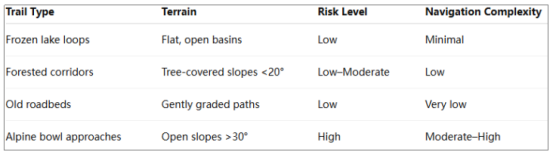
Only the first three categories are suitable for independent snowshoe travel without a guide.
III. Rocky Mountain National Park: Core Self-Guided Routes
Rocky Mountain National Park remains the most concentrated area for beginner-friendly snowshoeing near the central Rockies. The Bear Lake Road corridor and surrounding valleys offer a cluster of routes that are frequently used in winter and do not require guided access.
One of the most accessible options is Sprague Lake, a flat loop under a mile in length. The terrain is nearly level, making it suitable for first-time snowshoers and families. Nearby, the Bear Lake area serves as a gateway into deeper terrain, where snowshoe tracks often lead toward Dream Lake and Emerald Lake. These routes are more demanding but still commonly used without guides due to their established winter traffic and visible pathing.
Typical self-guided routes in this area include:
1. Bear Lake Trail – Rocky Mountain National Park, Colorado
● Distance: 0.6 miles loop
● Elevation Gain: 50 feet
● Difficulty: Easy
● Highlights: Panoramic views of Hallett Peak, frozen Bear Lake, wildlife spotting.
Notes: Well-maintained paths and clearly marked signs make this trail suitable for families and beginners.
2. Sprague Lake Trail – Rocky Mountain National Park, Colorado
● Distance: 0.8 miles loop
● Elevation Gain: Minimal
● Difficulty: Easy
● Highlights: Frozen lake, reflection photography opportunities, birdwatching.
Notes: Ideal for a short excursion or as part of a larger snowshoeing day.
3. The Emerald Lake Corridor – Rocky Mountain National Park, Colorado
● Distance: ~3.6 miles round trip
● Elevation Gain: ~650–770 feet
● Difficulty: Moderate (season-dependent in winter snow conditions)
● Highlights: Nymph Lake, Dream Lake, Emerald Lake, alpine cirque views, Hallett Peak backdrop
● Trailhead: Bear Lake Trailhead, Rocky Mountain National Park
The Emerald Lake corridor, in particular, is one of the most heavily traveled winter routes in the park. While it gains elevation, it remains intuitive due to constant use by snowshoers and winter hikers, which compresses the snow into a defined track.
IV. Estes Park and Western Approaches: Quiet Alternatives
Outside the main Bear Lake corridor, quieter snowshoeing experiences can be found near Estes Park and the western entrances of the park. These areas are often less congested but still suitable for independent travel.
The Lily Lake area provides one of the simplest snowshoe loops in the region. The trail remains relatively flat with minimal elevation gain, making it suitable for acclimatization before attempting higher routes. Similarly, sections around the Glacier Basin and Moraine Park areas offer wide, open valleys where navigation is straightforward and avalanche exposure is limited.
Local winter travel guides often emphasize that in these lower-elevation basins, snowshoeing becomes more about endurance than technical skill. The snow tends to be packed by wind and previous hikers, reducing the physical burden compared to untouched powder conditions.
V. Lesser-Known but Accessible Snowshoe Corridors
Beyond the most famous trails, several self-guided routes exist across the broader Rocky Mountain region that avoid technical complexity while still delivering high-quality scenery.
Old park roads are particularly important in this category. Roads that are closed to vehicles in winter often become snowshoe corridors due to their consistent grade and predictable direction. These routes are especially useful after heavy snowfall, when forest trails may become difficult to follow.
Common characteristics of these corridors include:
● Gentle, sustained incline rather than steep ascent
● Wide surface area allowing flexible navigation
● Frequent use by both snowshoers and cross-country skiers
● Minimal exposure to avalanche-prone slopes
These routes are not “official snowshoe trails” in many cases, but functionally they serve as the safest entry point for independent winter exploration in the Rockies.
VI. Safety Considerations for Independent Snowshoe Travel
Weather Awareness: The most significant hazard remains avalanche terrain, even in areas that appear forested or benign. The U.S. National Park Service emphasizes that snowshoe travelers should check avalanche forecasts, avoid slopes above 30 degrees when risk is present.
Navigation: Use maps, trail apps, or GPS devices. Even well-marked trails can be confusing after heavy snowfall.
Emergency Preparedness: Carry a first aid kit, extra food and water, and a charged mobile device. Notify someone of your planned route.
Clothing & Gear: Layering is essential. Wear moisture-wicking base layers, insulating mid-layers, and a waterproof outer shell. Gloves, hats, and gaiters protect extremities.
Essential considerations include:
● Snow depth significantly affects travel speed and fatigue
● Route familiarity reduces exposure to navigation errors
● Forest cover generally provides safer terrain than open alpine basins
● Physical exertion increases substantially compared to summer hiking
Even experienced hikers often reduce planned distances by half when transitioning to snowshoe conditions.
VII. Planning a Self-Guided Snowshoe Day
Effective planning in the Rockies requires adjusting expectations rather than simply transferring summer hiking logic into winter conditions. A 3-mile summer hike may take significantly longer in snow due to increased resistance and slower movement.
A typical self-guided winter day in the Rockies might include:
● Short morning approach on a packed corridor
● Midday ascent to a lake basin or viewpoint
● Early return before weather deterioration
Route selection should prioritize visibility and retreat options rather than elevation gain. Many successful snowshoe trips in the region are loop-based or out-and-back routes that allow easy reversal if conditions worsen.
(This article is for informational purposes only and does not constitute professional travel, navigation, or safety advice. Snowshoeing involves inherent risks, including sudden weather changes, avalanche exposure, and terrain hazards. Trail conditions can change rapidly, and readers are responsible for verifying current local conditions and exercising proper judgment before any trip. All activities are undertaken at the reader’s own risk.)
FAQs
1. Do I need snowshoeing experience to try these trails near the Rockies?
No prior experience is required for most beginner routes like Sprague Lake or Lily Lake, though basic winter hiking awareness is strongly recommended.
2. Can I snowshoe in Rocky Mountain National Park without a permit or guide?
Yes, most winter trails are open for self-guided travel, but park entry fees and seasonal access rules still apply.
3. What is the biggest risk when snowshoeing without a guide?
Avalanche exposure and navigation errors in changing weather conditions are the primary risks, even on moderate trails.
About Author
Adrian Calloway is a travel writer specializing in alpine environments, winter trekking, and backcountry route design across North America. His work focuses on translating technical mountain conditions into practical guidance for independent travelers seeking safe access to high-elevation landscapes. He has spent over a decade documenting winter travel corridors in the Rocky Mountain region and adjacent ranges.
References
[1] National Park Service. (2026). Snowshoeing in Rocky Mountain National Park.
[2] AllTrails. (2025). Snowshoeing trails in Rocky Mountain National Park.
[3] Snowshoe Magazine. (2023). Snowshoeing trails in Rocky Mountain National Park, CO.
If you enjoy exploring alpine winter routes like these, stay on this blog for more detailed field-tested guides to cold-season travel.
>>>>>>> 944e541ebad74151114cbae6b7f1c9ca1f8a9f02